
Volleyball Rules: A Beginner's Guide for 2026
Learn indoor volleyball scoring, rotation, contacts, faults, libero limits, and the 2026 FIVB tests, then turn each rule into a form check.
Better Form editorial team
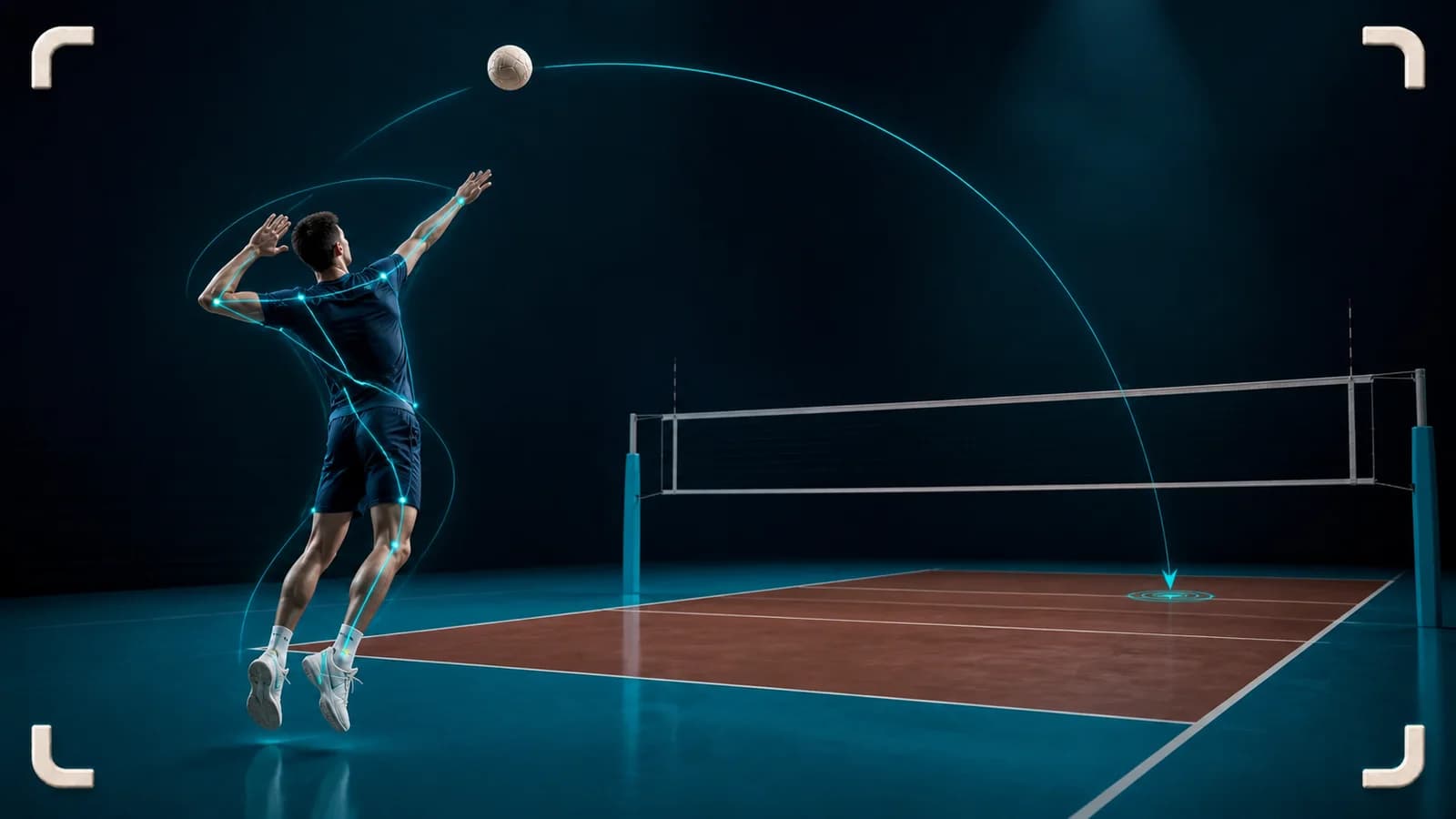
Volleyball AI turns volleyball rules into checks you can use in training: learn the rule, record your serve, approach, or block, review your form score, and practise one correction. The rules themselves are straightforward. Six players take the court for each team. You may use up to three team contacts to return the ball, a block does not consume one of those three contacts, and every rally awards a point. You rotate clockwise when your team wins the right to serve.
International indoor matches normally use best-of-five scoring. The first four sets go to 25 points, the fifth goes to 15, and a team must win every set by two. The FIVB 2025–2028 rulebook governs international play, but your school, college, club, or recreational league may use a different substitution, libero, or match format. Check the rule set for your competition when a local detail matters.
Volleyball rules at a glance
Use this table before your first match or practice.
| Rule | What you need to do | Common fault |
|---|---|---|
| Players | Put six players on court in six rotational positions. | Serving or receiving out of rotation. |
| Scoring | Win a rally to score a point. Win sets by two points. | Ending a set at 25–24 instead of continuing. |
| Contacts | Return the ball within three team hits; a block touch sits outside that count. | Taking four team hits. |
| Consecutive contacts | Do not contact the ball twice in a row, except where the block and first-contact rules permit it. | Setting or digging, then touching the next ball yourself. |
| Ball handling | Let the ball rebound; do not catch or throw it. | Holding, lifting, or carrying the ball. |
| Serve | Serve from behind the end line after the referee authorizes play. | Stepping on or over the end line before contact. |
| Rotation | Rotate one position clockwise after winning the serve from the other team. | Starting the rally in the wrong rotational order. |
| Net and centre line | Play without interfering with the opponent through the net or under it. | Touching the net between the antennae while playing the ball. |
| Back-row attack | A back-row player must take off from behind the attack line to complete an attack on a ball entirely above the net. | Jumping from the front zone for that attack. |
| Libero | Use the libero as a back-row defensive specialist within the competition's rules. | Blocking, attempting to block, or completing an illegal attack. |
The FIVB basic-rules guide gives the shortest official overview. Use the full rulebook when you need the exact wording for a disputed play.
How volleyball scoring works
Volleyball uses rally scoring, so one team receives a point after every rally. A team wins the rally when it grounds the ball in the opponent's court or when the opponent commits a fault. A ball that touches a boundary line counts as in.
In a standard international indoor match:
- Sets one through four go to 25 points.
- A deciding fifth set goes to 15 points.
- A team must lead by two points to win a set.
- A team wins the match by winning three sets.
That two-point margin removes the scoring ceiling. At 24–24, play continues to 26–24, 27–25, or the first later score with a two-point gap. At 14–14 in the fifth set, the same rule applies.
Some youth, school, and recreational formats play best-of-three matches or use shorter sets. USA Volleyball notes that scoring changes by format and that the deciding set normally goes to 15. Read USA Volleyball's rules overview before you assume that an international match format applies to your league.
How the three-contact rule works
Your team has up to three contacts to send the ball back across the net. A common sequence uses a pass, a set, and an attack, but you may return the ball on the first or second contact.
A block contact does not count as one of the team's three hits. The blocking team may therefore touch the ball at the net and still use three contacts to return it. The blocker may also take the next contact after the block.
The rulebook allows the ball to touch any part of your body, but you cannot catch or throw it. One player generally cannot contact the ball twice in succession. Exceptions matter on a block and on a team's first contact, where one continuous action can produce more than one contact under the rulebook's handling provisions.
When you practise, do not turn every imperfect pass into a rules argument. Ask whether you redirected a rebound or controlled and threw the ball. A referee judges the action, not whether the contact looked elegant.
How rotation and positions work
The six court positions form a serving order:
- Right back, the serving position.
- Right front.
- Middle front.
- Left front.
- Left back.
- Middle back.
When your team receives and wins a rally, you gain both a point and the serve. Every player then rotates one position clockwise. The player who moves into position one serves.
You must respect the serving order throughout the set. Under the standard 2025–2028 rules, the serving team must stay in its rotational order at the moment the server contacts the ball. Once the serve is in play, players may move into their tactical positions. That is why a setter can start in one rotational spot and sprint toward the net as soon as the rally begins.
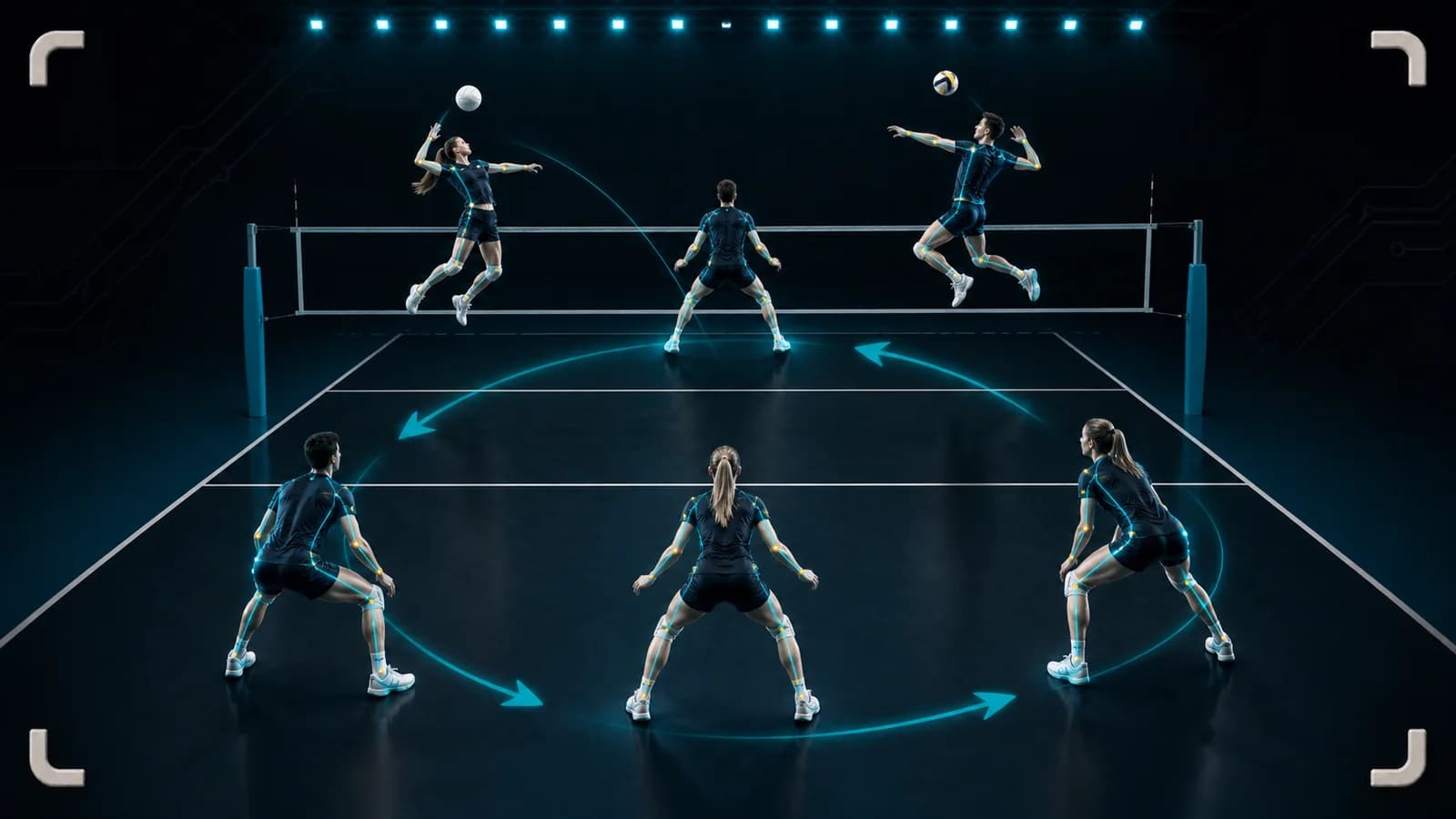
The 2026 international season adds a narrow caveat. The FIVB approved tests for selected competitions that let the receiving team leave its rotational positions when the server begins the serving action, rather than waiting for ball contact. The tests do not automatically rewrite every league's rules. The FIVB describes the 2026 test events and limits, so check which rulebook your event applies.
Turn one volleyball rule into a filmed check
Open Volleyball AI and choose one rule that changes a visible action: serving behind the end line, keeping a back-row take-off behind the attack line, or controlling your approach before contact. Record one attempt, review the form score and technique feedback, then practise one correction instead of trying to fix the whole rally at once.
Serving rules and foot faults
Serve from the service zone behind the end line. Wait for the referee's authorization, then contact the ball within the allowed time. At the moment of contact, you cannot touch the court, the end line, or the ground outside the service zone.
You may use an underhand or overhand action. The ball must cross the net inside the crossing space between the antennae. A serve that touches the net and continues into the opponent's court can remain in play.
Film a side view when you want to check a foot fault. Keep the end line, both feet, and the contact point inside the frame. Watch the moment your hand contacts the ball—not the end of your follow-through. You may land inside the court after contact.
Front-row, back-row, and attack-line rules
Front-row players may complete attacks and blocks near the net. Back-row players may attack too, but they face one important restriction: if the ball is entirely above the top of the net, they must take off from behind the attack line to complete that attack.
A back-row player may land in the front zone after taking off legally. The takeoff location controls the fault. A back-row player can also attack from the front zone when the ball is not entirely above the net at contact.

To review this action, place the camera outside the sideline and keep the attack line, takeoff foot, net tape, and contact point visible. Freeze the frame at takeoff and again at ball contact. That view gives you the two facts the rule requires.
Net, centre-line, and interference faults
Not every net touch creates a fault. Under the FIVB rules, a player commits a fault by contacting the net between the antennae while playing the ball. Touching the net outside the antennae does not automatically create a fault, but you still cannot use the net for support or interfere with play.
You may cross under the net when part of your foot remains on or above the centre line and you do not interfere with the opponent. Crossing completely into the opponent's court with a foot creates a fault. Other body parts may touch the opponent's court only when the action does not interfere and the feet meet the rule's centre-line condition.
Use a sideline view to check this safely in practice. Keep the centre line and both landing areas visible. Do not stage a collision to test the rule.
Libero rules
The libero wears a contrasting uniform and replaces back-row players without using a regular substitution. Only one libero may be on court at a time. Under international rules, the libero cannot serve, block, attempt to block, or complete an attack when the ball is entirely above the top of the net.
An additional setting restriction catches new teams: when the libero uses an overhand finger pass from the front zone, a teammate cannot complete an attack on that ball while it is entirely above the net. The same attack restriction does not apply when the libero makes that set from behind the attack line.
Domestic rule sets can differ. USA Volleyball explains that some rules allow the libero to serve in one rotational position, while international rules do not. Check the competition rulebook before you copy a libero pattern from another league.
Double contacts and the 2026 FIVB tests
The published 2025–2028 rules still prohibit a player from making two separate consecutive contacts outside the listed exceptions. For selected FIVB competitions in 2026, officials will continue a tested interpretation that allows a double contact during the setting action when the ball remains on the same side of the court.
Treat this as an event-specific interpretation, not a universal rule for every school or club match. The same FIVB announcement also lists tests for eight substitutions per set, roster and libero requirements, overhead-obstruction contacts, and receiving-team positioning. Your local rules may not adopt any of them.
Turn each rule into one form check
Reading the rulebook tells you what counts. Film tells you what you did. Use Volleyball AI when you want one consistent review loop for a serve, forearm pass, set, spike, or block.
- Pick one rule-linked action, such as serving behind the line or taking off behind the attack line.
- Frame the line, your full body, and the ball-contact area.
- Record several normal attempts.
- Review your form score and technique feedback.
- Choose one correction and repeat the same camera angle.
Volleyball AI does not replace a referee's ruling, your coach's judgment, or your competition's rulebook. It helps you see your timing and body positions so you can practise one visible correction instead of guessing.
If you want to improve the recording itself, use our basketball shooting camera guide for framing principles that also apply to fast court movements. You can also compare the different jump and landing demands in volleyball and basketball or browse more court-sport guides.
Frequently asked questions
How many players play indoor volleyball?
Each team puts six players on court. Teams may list substitutes and liberos according to the competition's roster rules.
How many times can a team touch the ball?
A team may use up to three contacts to return the ball. A block touch does not count as one of those three contacts.
Do volleyball players rotate after every point?
No. Your team rotates clockwise when it wins a rally while receiving and therefore gains the right to serve. If your team already served and wins the rally, you score without rotating.
Can a volleyball player touch the net?
A player commits a fault by touching the net between the antennae while playing the ball. Incidental contact outside the antennae is not automatically a fault, but interference and using the net for support remain illegal.
What score wins a volleyball set?
In international indoor volleyball, the first four sets go to 25 and a deciding fifth set goes to 15. A team must win by two points.
Are the 2026 FIVB tests permanent rule changes?
No. The FIVB approved them for named 2026 international competitions and said any update to the official rules would follow review during the testing phase. Use the rulebook assigned to your event.
Final recommendation
Use Volleyball AI as a training companion when you want to record the movement, review a form score, and work on one correction while the official rulebook remains the authority for every call.
Volleyball Coach
Volleyball specialist
Volleyball Coach is the AI coaching persona behind Volleyball AI.