
How to Play Pickleball: Rules for Your First Game
Learn how to play pickleball, serve legally, follow the two-bounce and Kitchen rules, keep score, and complete your first game with confidence.
Better Form editorial team
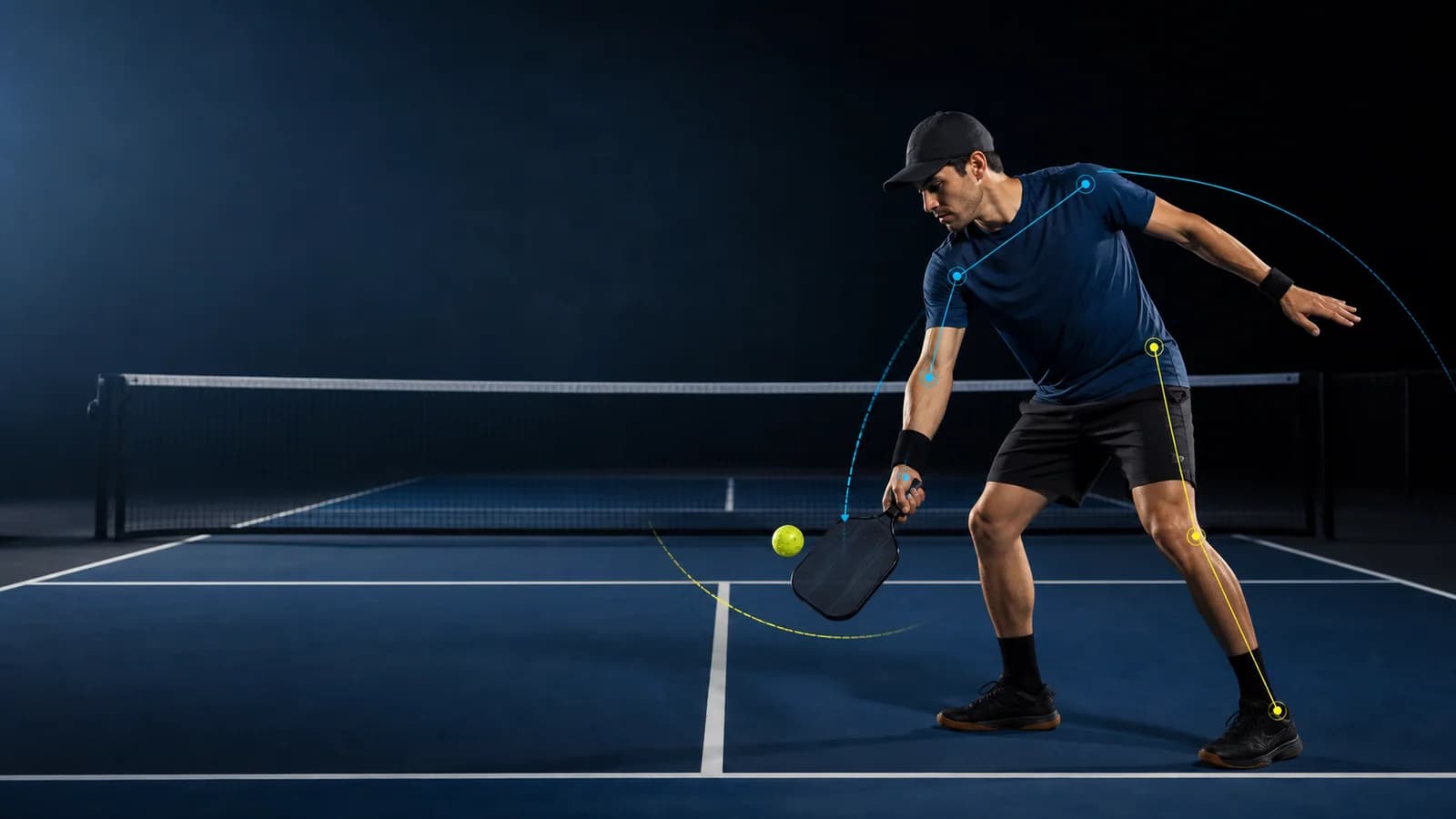
To play pickleball, serve diagonally, let the serve and return bounce before anyone volleys, stay out of the Kitchen when you volley, and keep playing rallies until a fault. For a typical recreational doubles game with traditional side-out scoring, only the serving team scores; games normally go to 11 and you must win by 2. USA Pickleball's rules summary is the authority to check when a local rule, league, or tournament format differs.
You do not need to memorize a rulebook before you start. Learn the order of a rally, call the score before you serve, and play a short game. This guide gives you enough detail to do that without turning your first session into a rules seminar.
On this page
- What you need and where to stand
- The first-game rules in six steps
- How scoring works in doubles
- A first-session plan
- How to check the movement you just learned
What you need and where to stand
For a casual first game, bring a paddle, a pickleball, a net, and one to three other people. You can play singles or doubles, but doubles gives each player less court to cover and makes it easier to learn the sequence with a partner.
A standard court is 20 feet wide by 44 feet long for both singles and doubles. The net divides it in half; each side has a right and left service court, and the non-volley zone sits next to the net. The Global Pickleball Federation rulebook shows the court geometry and dimensions. See the court rules and diagram.
| Court area | What you use it for | First-game reminder |
|---|---|---|
| Baseline | Serving and receiving depth | Serve with at least one foot behind it. |
| Right and left service courts | Diagonal serves and returns | Your serve travels crosscourt to the opposite box. |
| Non-volley zone (the Kitchen) | A 7-foot area on each side of the net | You can enter after a bounce; you cannot volley while touching it. |
| Sidelines and baselines | The outer boundaries | A ball that lands outside them is out. |
The Kitchen is a rule area, not a place you must avoid all match. You may step into it to hit a ball that has bounced. The restriction applies to volleys: if you hit the ball out of the air, do not touch the Kitchen or its line, and do not let your momentum carry you into it after contact. USA Pickleball's beginner rules explain the same distinction.
The first-game rules in six steps
Use these six steps in order. They describe a standard doubles game using traditional side-out scoring, which is the format many new players meet first.
1. Choose who serves first
Use any fair method to choose the first serving team. In doubles, the first server starts on the right side of the court. Before every serve, call the score clearly enough for all four players to hear it.
At the start of a traditional doubles game, the first serving team gets one server before the serve transfers to the other team. That is why the opening call is commonly 0-0-2: serving score, receiving score, then the server number. You do not need to understand every scoring edge case to begin; you only need to say the score before you serve and keep the sequence honest.
2. Serve diagonally and legally
Serve from behind the baseline and send the ball diagonally into the opponent's service court. The serve must clear the net and the Kitchen line; a serve that lands on the Kitchen line is a fault.
For a volley serve, your arm moves in an upward arc, you strike the ball below your waist, and the paddle head stays below the highest part of your wrist at contact. A drop serve is also allowed, with its own requirements. The USA Pickleball rules summary gives the current serve wording, so use it rather than a social-media shortcut when you want to settle a question.
Keep your first serves simple. Stand behind the baseline, pick the diagonal service box, and use a controlled motion that gives you room to clear the net. You are trying to start the rally, not hit the hardest ball of the day.
3. Let the first two shots bounce
After the serve, the receiving team must let the ball bounce before returning it. Then the serving team must also let that return bounce before hitting it back. Only after those two bounces may either team volley or play the ball after a bounce.
This is the two-bounce rule. It prevents a server from rushing straight to the net for an immediate volley and gives both teams time to enter the rally. When you are new, say “bounce, bounce” before the serve. It is a useful reminder, not an official call. USA Pickleball's summary confirms the sequence.
4. Rally until somebody makes a fault
Once the return has bounced, keep the ball in play. You may hit it out of the air outside the Kitchen or let it bounce first. The rally ends when someone faults, such as by hitting the ball into the net, outside the court, letting it bounce twice, or volleying illegally in the Kitchen.
For a first game, do not stop every rally to debate a close ball. Make your best call, replay the point if everyone agrees that no one saw it clearly, and keep moving. If you play in a league or tournament, use its procedures and the current official rulebook for the precise ruling.
5. Respect the Kitchen on volleys
The Kitchen is the full 14-foot zone around the net: 7 feet on each side. You may stand there and hit a ball that bounced. You may not volley while you touch the zone or its line.
The part that catches beginners is momentum. If you volley from outside the Kitchen but your movement carries you into the zone afterward, that is also a fault. Leave a little space behind the line when you set up for a volley. You will learn to move closer as you get comfortable with balance and control.
6. Reset for the next point
After a rally, award the point or change the server, say the new score, and begin again. This tiny reset prevents most beginner scoring confusion. Do not serve while someone is still asking what the score is.
How scoring works in doubles
Traditional side-out scoring sounds complicated because doubles includes two possible servers on each side. Use this table until the rhythm becomes familiar.
| What happened? | What changes next? |
|---|---|
| The serving team wins the rally | It scores one point. The server and partner switch left-right sides; the same player serves again from the other side. |
| The first server's team loses the rally | No point. In a normal service turn, the partner becomes the second server. |
| The second server's team loses the rally | No point. It is a side-out: the other team serves, starting from the right side. |
| The receiving team wins the rally | It does not score under traditional side-out scoring; it receives the next serve according to the sequence above. |
The score call in doubles has three numbers:
- The serving team's score.
- The receiving team's score.
- The server number: 1 or 2.
So 4-2-1 means the serving team has four, the receiving team has two, and the first server is serving. If the serving team wins the rally, the score becomes 5-2-1 and that server switches sides. If the first server loses the rally, it becomes 4-2-2: same team score, second server now serving.
Games normally go to 11, win by 2. Some events use games to 15 or 21, and some venues use rally scoring, where a point follows every rally. Agree on the format before you start; do not assume that every open-play game uses the same scoring system. USA Pickleball lists both traditional and rally scoring.
The simple singles version
Singles removes the second-server number. Call two numbers: server score, then receiver score. With an even score, the server serves from the right side; with an odd score, the server serves from the left. The serve, two-bounce, Kitchen, and fault rules remain the same.
The three moments that confuse new players
“Can I volley in the Kitchen if the ball is high?”
No. Height does not change the non-volley-zone rule. If you want to hit a ball while you are in the Kitchen, let it bounce first. If you want to volley, establish yourself outside the Kitchen and make sure your follow-through does not carry you into it.
“Does a ball on the line count?”
Usually, a ball that touches a court line is in. The important serving exception is the Kitchen line: because that line belongs to the non-volley zone, a serve that touches it is a fault. The USA Pickleball beginner guide covers this exception.
“Why did my partner lose the serve after I already lost mine?”
In traditional doubles scoring, each team normally has two serving turns, one for each player, before the serve goes to the other team. The opening service sequence is the exception: the starting team has only one turn. State the third number in the score call and the sequence gets much easier to follow.
A first-session plan that teaches the rules
Spend your first 30 minutes learning the rally order before you worry about tactics. This plan keeps each drill short enough that you can remember what you are practising.
- Serve and catch for 5 minutes. Stand behind the baseline and serve diagonally to a partner who catches the ball. Change sides after five serves. You are checking the location and legal start, not power.
- Serve, return, then stop for 5 minutes. The receiver lets the serve bounce, returns it after the bounce, and the serving side catches the return after its required bounce. Say “bounce, bounce” until the sequence feels automatic.
- Kitchen walk-through for 5 minutes. Stand near the line. Hit a bounced ball from the Kitchen, then step back and volley without touching the line. Repeat slowly. You are teaching your feet where the rule changes.
- Play a half-court cooperative rally for 5 minutes. Start with a legal serve and return, then keep the ball going at a pace that lets everyone track the two-bounce rule. Stop if someone rushes to volley too early; restart the sequence.
- Play a short game for 10 minutes. Use side-out scoring to 5, win by 2. Call every score aloud. When the score sequence breaks, pause, reconstruct the last rally, and continue rather than guessing.
This session gives you a real game model: serve, return, first bounce, rally, fault, score, reset. It also makes the rule questions show up in context, where they are easier to remember.
Turn your first session into one clear practice goal
Rules tell you what you are allowed to do. Video can show you what you actually did when you tried to do it.
After the first game, choose one movement to film: your serve or your third-shot drop. Set a phone behind the baseline or outside the sideline where it stays safe and captures your feet, paddle, and contact area. Record several attempts, not just the one that felt best. The goal is to see a repeatable pattern, not to freeze-frame one lucky shot.
Start with three visible questions:
- Did you begin the serve behind the baseline and send it to the diagonal box?
- After the return, did you let the ball bounce before you moved into a volley position?
- On your third shot, could you recover toward a useful ready position without drifting into the Kitchen on a volley?
For a more focused review, Pickleball AI analyzes training video and displays an overall score with technique feedback. Use that second look to choose one visible practice target; it does not replace a qualified coach or decide a rules call for you.
If you want a broader filming setup, our tennis serve camera guide explains how to frame a fast racket motion without cutting off the ball or your feet. You can also explore the racket-sport guides, compare padel and pickleball, or see how table tennis and pickleball use different spacing and timing.
For the complete 2026 rules, including rally scoring, the latest serve changes and line-call disputes, read the pickleball rules guide.
Frequently asked questions
Is pickleball hard to learn?
You can learn the basic rally order in one session: serve diagonally, let the serve and return bounce, then rally while respecting the Kitchen. Scoring takes more attention in doubles, so start with a short game and call every score aloud.
Can beginners serve overhand in pickleball?
No. A volley serve must follow the underhand requirements in the current rules: an upward arm arc, contact below the waist, and the paddle head below the highest part of the wrist. A drop serve is a separate permitted option. Check USA Pickleball's serve summary for the full language.
Can I stand in the Kitchen in pickleball?
Yes, when you are going to play a bounced ball. You cannot volley while touching the Kitchen or its line, and you cannot volley outside it and then let your momentum carry you into it.
What score do you play pickleball to?
Traditional games normally go to 11 points and require a two-point margin, according to USA Pickleball's rules summary. A league or tournament can choose another format, so agree on the format before you play.
What should I practise after my first pickleball game?
Choose one action you saw repeatedly: placing a legal serve, waiting for the return to bounce, staying clear of the Kitchen on volleys, or recovering after a third shot. Film a small set of attempts, pick one correction, and repeat the same view after you practise it.
Pickleball Coach
Pickleball specialist
Pickleball Coach is the AI coaching persona behind Pickleball AI.