

How to Increase Golf Swing Speed: 8-Week Plan
Add club head speed with the plan the studies tested: 8 weeks of strength, jumps, speed sets and a better warm-up, with the mph each method added.
Golf technique editor
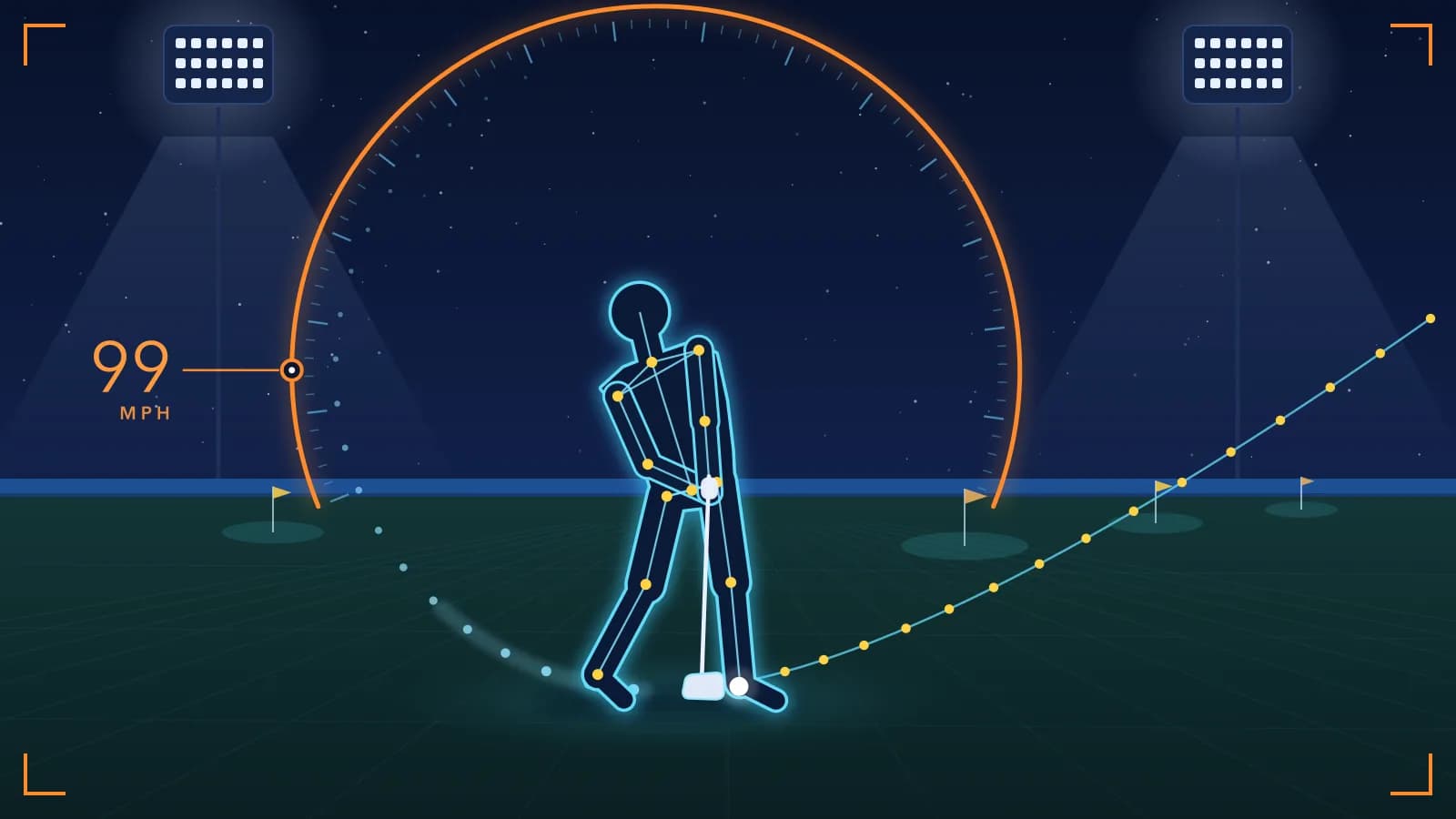
To increase your golf swing speed, train strength and power twice a week, add short sets of all-out swings, warm up with jumps instead of long stretches, and fix the sequence that leaks speed. In a 2021 review of 20 studies, programs that mixed gym work with fast, golf-specific drills raised club head speed by 4.1% on average and hitting distance by 5.2%, about 4 mph on a 95 mph driver swing, and the best results came from 8-week programs (Uthoff and colleagues, 2021).
You get the yards each mph buys, the free yards hiding in your strike and launch, what each method added in controlled studies, an 8-week plan for the gym or your garage, and the changes that matter after 50. Every number links to the study or the data set behind it.
How much distance does 1 mph of swing speed add?
About 2.5 to 3.5 yards of driver carry, a little more the faster you already swing. TrackMan puts it at up to 3 yards per mph of club speed and up to 2 yards per mph of ball speed. A 4 mph gain is worth roughly 10 to 13 yards off the tee, often a full club less into the green.
Your ball speed depends on your strike as much as on your speed. Smash factor, your ball speed divided by your club speed, tells you how well you convert one into the other. TrackMan's own example: two golfers swing at 100 mph, one with a 1.40 smash factor and one with 1.50, and the second hits it about 20 yards farther with the same swing speed.
Here is where TrackMan Combine's averages put each handicap group with a driver:
| Group | Club speed | Ball speed | Smash factor |
|---|---|---|---|
| Men, scratch or better | 110 mph | 161 mph | 1.49 |
| Men, 5 handicap | 101 mph | 147 mph | 1.45 |
| Men, 10 handicap | 95 mph | 138 mph | 1.45 |
| Men, average golfer (14.5 handicap) | 94 mph | 133 mph | 1.44 |
| Men, bogey golfer | 92 mph | 131 mph | 1.43 |
| Women, scratch or better | 90 mph | 131 mph | 1.46 |
| Women, 5 handicap | 87 mph | 125 mph | 1.45 |
| Women, 10 handicap | 83 mph | 119 mph | 1.44 |
| Women, 15 handicap | 79 mph | 111 mph | 1.41 |
Look at the step from a 10 handicap man to a scratch man: 15 mph more club speed and 23 mph more ball speed. Every group that scores better in TrackMan's data also swings faster, and the scratch groups strike it most efficiently. Type your own speed into the swing speed to distance calculator and you see your carry, your driver total and the yards each extra mph adds, for any club from driver to pitching wedge.
Get the free yards first: strike and launch
Check what you lose at impact before you chase a single mph. A 2024 study put it in numbers with one 7 iron: golfers averaging a 29 handicap swung only 5.3 mph slower than golfers averaging a 4 handicap, yet they lost 17.6 mph of ball speed and 38 yards of carry (Yang and colleagues, 2024). More than half of that ball speed gap came from the strike.
Then check your launch. TrackMan's average male amateur swings his driver at 93.4 mph, hits down on it by 1.6 degrees, launches it at 12.6 degrees with 3,275 rpm of spin and carries it 204 yards. Feed 93 mph into TrackMan's optimizer and you get 214 yards with launch and spin matched to that downward strike, and 232 yards with a strike 7.5 degrees up (TrackMan). That is up to 28 yards with zero extra speed.
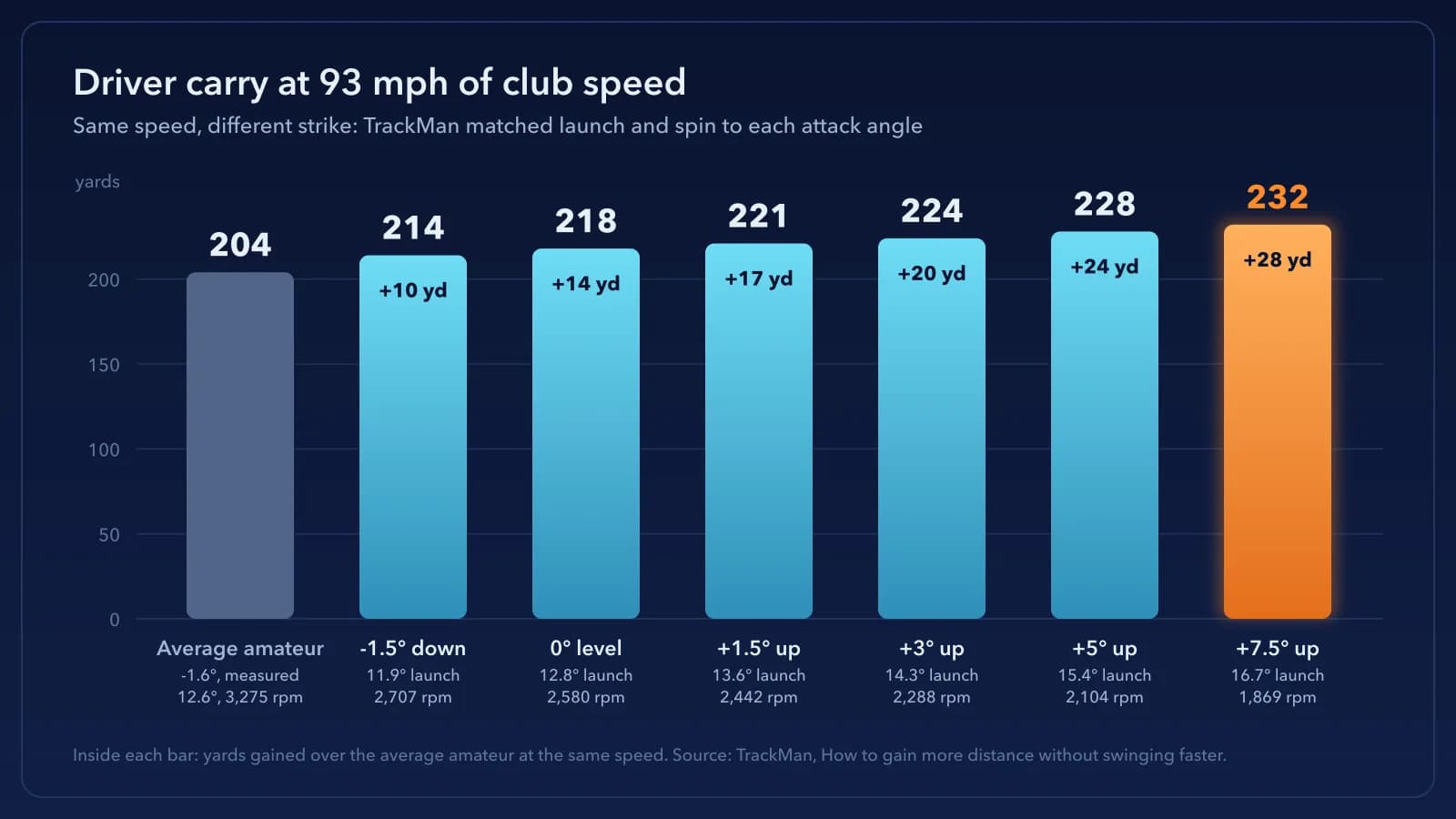
Three changes move you up that chart:
- Tee it higher and play it forward. Set the ball off your lead heel so the club meets it after the bottom of its arc. One coach in TrackMan's notes watched a player's ball speed rise from 152 mph to 166 mph when the ball moved forward, in line with his lead toe (TrackMan).
- Strike the center of the face. Spray the face with foot powder or stick an impact label on it, hit five drives and look at the marks. Use the driver swing checkpoints to set your posture and ball position before you change anything else.
- Get your driver fitted for loft and shaft weight. In the same 7 iron study, a 77 g shaft gave the low handicappers about 1 mph more club speed and 6 yards more carry than a 114 g shaft.
See what each method added in the research
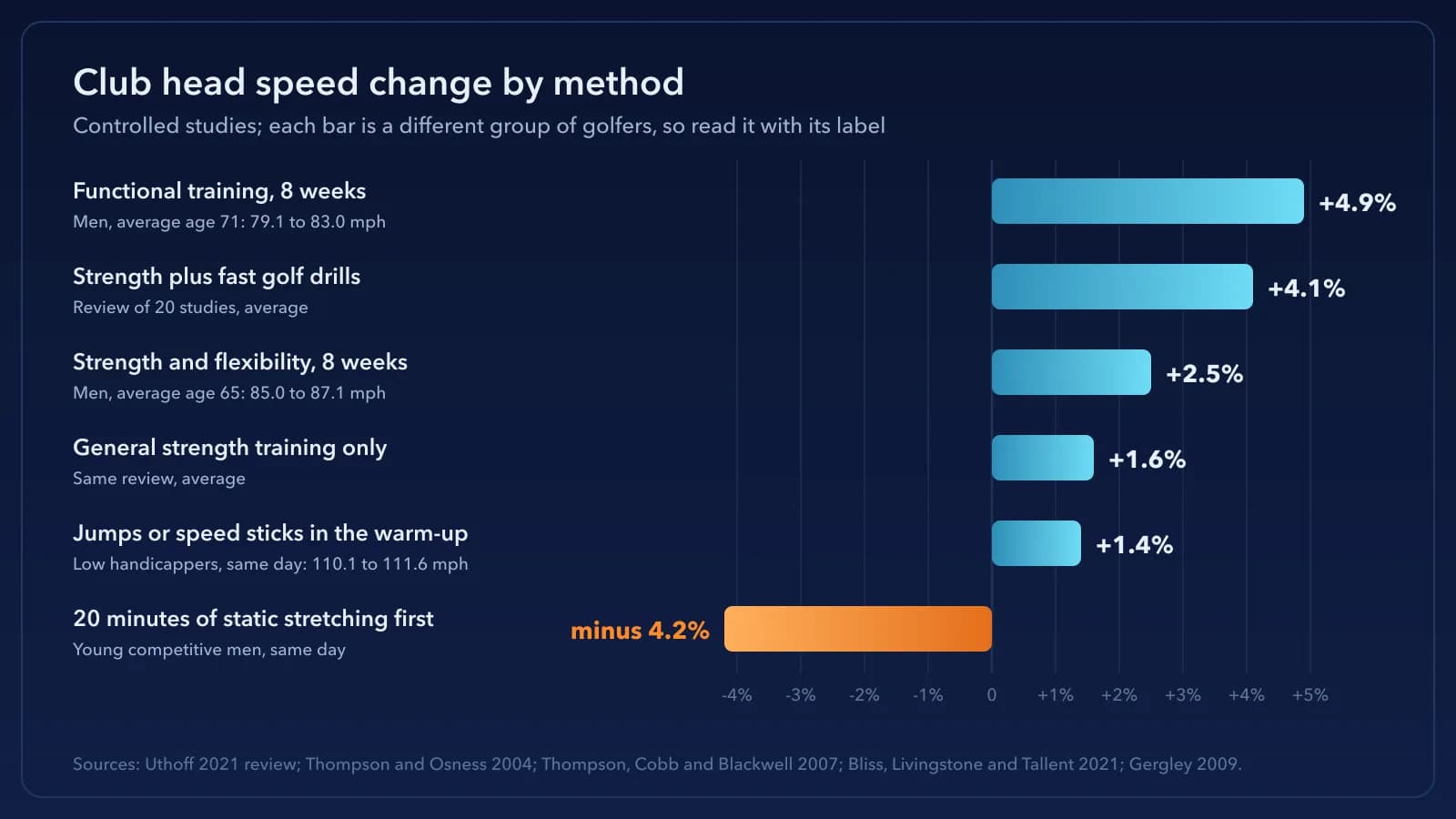
Here is what each method changed in controlled studies, as a share of club head speed. The studies tested different golfers, so read each bar with its group.
| Method | Golfers | Change in club speed |
|---|---|---|
| Strength plus fast, golf-specific drills | Review of 20 studies | +4.1% on average |
| General strength training only | Same review | +1.6% on average |
| Functional training: flexibility, core, balance, resistance | Men, average age 71, 8 weeks | +4.9% (79.1 to 83.0 mph) |
| Strength and flexibility program | Men, average age 65, 8 weeks | +2.5% (85.0 to 87.1 mph) |
| Jumps or speed sticks at the end of the warm-up | Low handicappers, same day | +1.4% (110.1 to 111.6 mph) |
| 20 minutes of static stretching before hitting | Young competitive men, same day | minus 4.2% |
Two patterns stand out. First, programs that train fast, golf-shaped movements beat plain strength work: 4.1% against 1.6% in the 2021 review, whose authors found the best results in 8-week programs with 3 to 4 sets of 5 to 15 reps at high speed. Second, power predicts speed better than flexibility. A 2021 meta-analysis found that club head speed tracked upper body power (r = 0.51) and lower body strength (r = 0.46), while flexibility showed almost no link (r = 0.03). Squat strength, jump power and medicine ball throws had the strongest single links, r = 0.55 to 0.63 (Ehlert, 2021).
Train strength and power twice a week
Build each session around the three moves whose tests tracked speed best in that meta-analysis: a squat, a jump and a medicine ball throw. Plan two sessions a week of about 40 minutes, with at least two days between them.
- Goblet squat or trap bar deadlift: 3 to 4 sets of 5 reps. Pick a weight you could lift twice more with clean form.
- Countermovement jump: 3 sets of 5. Dip fast, jump as high as you can, land softly, rest a full minute.
- Rotational medicine ball throw: 3 sets of 5 per side against a solid wall, with a 2 to 4 kg (4 to 9 lb) ball. Throw each one as hard as you can.
- Split squat: 2 to 3 sets of 8 per leg, holding dumbbells once bodyweight feels easy.
- Side plank: 2 sets of 30 seconds per side, for the trunk endurance your back needs.
Keep every jump and throw fast. When a set slows down, stop it there: speed work only counts at full speed. Add a little weight to the lift whenever every set feels smooth.
Swing fast on purpose with speed sets
Speed sets give you practice at your top speed: a handful of all-out swings with full rest, three days a week, after your warm-up.
- Turn your driver upside down and hold it just under the head, or use a light alignment stick.
- Make 3 sets of 5 swings as fast as you can while you still hold your finish. Listen for the whoosh at the bottom, in front of the ball position.
- Rest 60 to 90 seconds between sets.
- Finish with 5 full-speed swings with your real driver, hitting balls into a net or on the range, with a radar reading if you have one.
Independent research on overspeed sticks is thin. In a 2021 controlled trial with 13 golfers of a 1.0 average handicap, a warm-up with speed sticks raised club head speed from 110.1 to 111.6 mph and carry from 261.5 to 268.2 yards. A warm-up with countermovement jumps and plyometric push-ups gave the same 1.5 mph, and neither changed ball speed or total distance (Bliss, Livingstone and Tallent, 2021). Use sticks if you like them, and weigh the bigger online claims against that trial.
Warm up with jumps and fast swings
Your warm-up decides how much of your speed shows up on the first tee. In 15 young competitive golfers, 20 minutes of total-body static stretching before hitting cut club head speed by 4.19%, distance by 5.62% and accuracy by 31% compared with an active warm-up with clubs (Gergley, 2009). Dynamic stretching beat static stretching by 1.9 m/s of club head speed, about 4 mph, with a 5 iron (Moran and colleagues, 2009).
Borrow the warm-up from the 2021 speed stick trial, trimmed a little. It takes about 10 minutes:
- Skip or march on the spot for 2 minutes.
- Make 10 leg swings and 10 lunges with a rotation on each side.
- Hold a club over your head and make 12 overhead squats.
- Hit 3 pitch shots, 3 full wedges, 2 seven irons and 2 drivers.
- Finish with 3 sets of 10 countermovement jumps, then rest a minute before your first speed swing or tee shot.
Save long static stretches for after your round or your session.
Fix the sequence that leaks speed
Your speed starts from the ground. A 2026 systematic review of 24 studies found moderate to strong links between club head speed and the way golfers push into the ground or shift their pressure in 9 of them, and better golfers produced higher ground forces (Watson and colleagues, 2026).
Your upper body then has to lag your hips. In 100 recreational golfers, more separation between torso and pelvis at the top, and faster torso rotation on the way down, went with faster ball speed (Myers and colleagues, 2008).
Two drills train that order:
- Step drill. Set up with your feet together. As the club nears the top, step your lead foot toward the target into your normal stance, then swing. You feel your weight land on your lead side before your arms fire.
- Pause at the top. Hold the top for one second, start down with your lead hip turning, and let the club arrive last. Hit 5 balls at 70% speed, then 5 at full speed.
Learn the phases in the golf swing sequence guide, check your fundamentals with the golf swing basics, and keep your rhythm with the golf swing tempo trainer.
Check the shift on video. Record a face-on swing with Scratchmaxx (formerly Golf AI: Swing Coach) on Android and read how far your hips moved toward the target by impact, in inches. A number close to zero means you hang back, so go straight back to the step drill.
Follow the 8-week plan
Run strength on two days, speed sets on three, and test on the first and last day. The 8 weeks match the length of the programs in the research.
| Weeks | Strength and power (2 days) | Speed sets (3 days) |
|---|---|---|
| 1 and 2 | Learn each move: 3 sets, moderate weight, every rep fast | 3 sets of 5 swings |
| 3 and 4 | Lift 4 sets of 5, heavier; jumps and throws 4 sets | 4 sets of 5 swings |
| 5 | Lighter week: 2 sets of everything | 2 sets of 5 swings |
| 6 to 8 | Lift 4 sets of 4 to 5, heaviest yet; jumps and throws 4 sets | 4 sets of 5, then 5 drives at a ball |
A week can look like this: strength on Monday and Thursday, speed sets on Tuesday, Friday and Saturday, and a rest day before you play.
Test the same way both times. Use the same radar or launch monitor after the same warm-up, hit 10 drives a minute apart, as the 2021 trial did, and average all 10. A single best swing can fool you either way.
The review's 4.1% average would take a 95 mph swing to about 99 mph and add roughly 11 yards of carry. Put your before and after speeds into the swing speed to distance calculator to see your own gain, then rebuild your yardage card with the golf club distance chart.
Run the plan at home
You need a light stick or your flipped driver for speed sets, a medicine ball and a solid wall for throws, and a loaded backpack for squats and split squats. Do speed sets outside or under a ceiling high enough for a full swing, and check that nobody stands nearby before each set.
Train for speed after 50
You can still gain speed. In 31 men with an average age of 65, an 8-week strength and flexibility program raised club head speed from 85.0 to 87.1 mph (Thompson and Osness, 2004). In 18 men with an average age of 71, 8 weeks of functional training with flexibility, core, balance and resistance work raised it from 127.3 to 133.6 km/h, about 79 to 83 mph, while the control group stayed flat (Thompson, Cobb and Blackwell, 2007).
Adapt the plan to your body:
- Start the lifts with bodyweight and bands, and add weight only when 3 sets of 10 feel easy.
- Swap jumps for fast calf raises or medicine ball chest passes if your knees or hips complain.
- Add one balance drill per session, such as standing on your lead leg for 30 seconds.
- Keep speed sets to 3 days a week and stop any drill that brings pain.
Your back deserves the most care. Low back pain makes up 18% to 54% of documented golf ailments, and a 2014 review linked it to too much play and practice, poor trunk endurance and stiff lead hips (Lindsay and Vandervoort, 2014). See your physician before you start if you have heart disease, high blood pressure, osteoporosis, a joint replacement or back pain that runs down your leg, and see a physiotherapist or coach if a drill hurts.
Avoid the mistakes that cost you speed
| Mistake | What it costs you | Fix |
|---|---|---|
| Swinging harder with the same sequence | TrackMan Master Dom DiJulia sees golfers gain a few mph and lose 15 to 30 yards to poor contact | Train speed in sets, then groove it at 80% on the range |
| Static stretching for 20 minutes before you play | 4.2% of club speed and 5.6% of distance | Use the dynamic warm-up and finish with jumps |
| Hitting down on your driver | Up to 18 yards of carry at 93 mph | Tee it higher and play it off your lead heel |
| Judging progress on one big swing | A false reading either way | Average 10 drives after the same warm-up |
| Speed work every day | More stress on your lower back | Keep speed sets to 3 days with rest between |
Check your grip as well: the proper golf grip guide shows you how to hold the club securely without your hardest squeeze.
Answer your swing speed questions
How fast should you swing a driver?
TrackMan Combine's average 14.5 handicap man swings 94 mph, a 10 handicap 95 mph and a scratch golfer 110 mph. Women average 79 mph at a 15 handicap and 90 mph at scratch. Tour players averaged 115 mph on the PGA TOUR and 96 mph on the LPGA in TrackMan's 2023 data.
How long does it take to increase swing speed?
The programs in this guide ran 8 weeks, and the 2021 review found its best average gains in 8-week programs. A warm-up with jumps adds about 1.5 mph for that session only.
Can you increase swing speed at home?
Yes. Speed sets need a light stick or a flipped driver, throws need a medicine ball and a wall, and squats work with a backpack. Check your ceiling and your surroundings before every full swing indoors.
Do speed sticks work?
In a 2021 controlled trial, a speed stick warm-up added 1.5 mph, the same as bodyweight jumps. Use them for speed sets if you like them, and remember that the jumps cost you nothing.
Can seniors increase swing speed?
Yes. Men with average ages of 65 and 71 gained 2.1 and 3.9 mph in 8-week programs. Clear your plan with your physician first if you have a heart, bone or joint condition.
Golf Coach
Golf technique specialist
Golf Coach is the coaching persona behind Golf AI: Swing Coach. It explains the product's intended video-review workflow and does not replace a qualified coach.
Related Articles
Train Golf with AI
Golf AI: Swing Coach has no verified public App Store listing yet. Check release status on the product page and use the free article worksheet now.