
How to Dribble a Basketball: 7 Drills to Control the Ball
Learn how to dribble a basketball with your finger pads, eyes up and the ball below your waist, then run 7 drills 15 minutes a day to handle with both hands.
Better Form editorial team
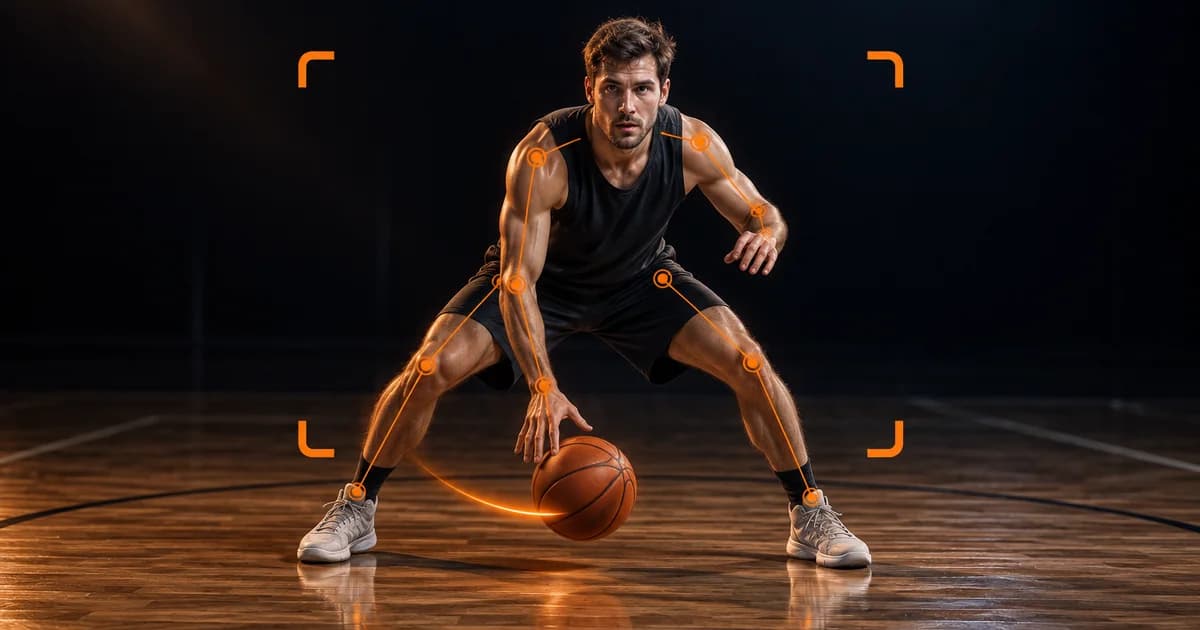
To dribble a basketball, push the ball into the floor with the pads of your fingers, keep it at or below your waist, and keep your eyes up on the court. Bend your knees, stay balanced, and shield the ball with your body and your free arm. Practice with both hands every day, first standing still, then on the move.
Below you get the five basics, the rules that end your dribble, seven drills and a 4-week plan you can run in 15 minutes a day.
Learn the five basics of a controlled dribble
The Jr. NBA teaching guides list these core points. Work through them in this order:
- Control the ball with your finger pads. Spread your fingers and keep your palm off the ball. Your fingers steer the ball; your palm slaps it.
- Push the ball down with your arm and wrist. Extend your elbow and snap your wrist toward the floor. Meet the ball on the way up and ride it with your fingers before the next push.
- Keep the ball at your waist or lower. A lower bounce comes back faster and gives a defender less time to reach it.
- Keep your head up. Look at the rim, your teammates and the defense. The ball comes back to the same spot when your push stays the same, so you can trust it without looking.
- Protect the ball with your body. Stand with your feet about shoulder-width apart and your knees bent, put your body between the ball and the defender, and hold your free arm up as a shield.
Hold that stance for every drill below. If you stand tall, your dribble rises and a defender can step into your space.
Stay legal: know what ends your dribble
FIBA's Official Basketball Rules define a dribble as the movement of a live ball when you throw, tap, roll or bounce it on the court. Your dribble ends when you touch the ball with both hands at once or let it come to rest in one or both hands. Three violations catch beginners:
| Violation | What you did | How you fix it |
|---|---|---|
| Double dribble | You dribbled again after your dribble ended | Pass, shoot or pivot once you pick up the ball |
| Carrying | You put your hand under the ball and carried it, or paused it and kept dribbling | Keep your hand on top or on the side of the ball |
| Travelling at the start | You lifted your pivot foot before the ball left your hand | Push the ball out first, then take your step |
The rules set no limit on your steps while the ball is out of your hand, so a long push on a speed dribble is legal.
Run these 7 dribbling drills
Start each drill with your weaker hand. Work for 30 seconds per hand, rest 15 seconds, and switch.
1. Pound the ball in place
Dribble hard at waist height with one hand, as if you want the ball to dent the floor. Keep your fingers spread and your elbow bent. The harder you push, the faster the ball returns, and the more control you feel.
2. Drop into low control dribbles
Lower your stance and dribble fast at ankle height. Short, quick touches train your fingers to steer the ball when a defender crowds you.
3. Push a V dribble in front of you
With one hand, push the ball side to side in front of your body in a V shape, catching it on the outside of your hand each time. This teaches you to move the ball across your body without crossing over.
4. Cross over from hand to hand
Push the ball low across your body, below your knees, from one hand to the other. Step your outside foot with the ball so your body stays between the ball and the defender. Our crossover technique guide breaks the move into its stance, push and catch.
5. Go between your legs
Take a wide stance with your left foot forward. Bounce the ball with your right hand through the gap between your legs to your left hand. Switch your feet and go back the other way. Keep the bounce low and quick so your knees stay out of the way.
6. Dribble two balls at once
Dribble two balls at the same time, first together, then alternating. You cannot favor your strong hand, so your weak hand catches up fast.
7. Call out numbers while you dribble
Ask a partner to stand in front of you and hold up fingers while you dribble any of the drills above. Call out each number as soon as it changes. You cannot see the number if you look at the ball, so this drill forces your eyes up. No partner? Watch a clock across the gym and call out the seconds.
Build your 4-week dribbling plan
Train 15 minutes a day, four or five days a week. Before week 1, test yourself: count how many clean low crossovers you make in 30 seconds without losing the ball or looking down. Repeat the same test at the end of week 4.
| Week | Drills | Goal for the week |
|---|---|---|
| 1 | Pound, low control, V dribble | Keep the ball at your waist or lower with either hand |
| 2 | Add crossovers and between the legs | Keep every bounce below your knees |
| 3 | Add two balls and number call-outs | Keep your eyes up for every rep |
| 4 | Move it: zigzag the court with crossovers at each turn | Change hands at speed without losing the ball |
In week 4, set up five markers in a zigzag down the court. Dribble to each one, cross over, and push hard to the next. Walk the pattern first, then jog, then run. Our basketball workout at home gives you more ball-handling work when you cannot get to a court.
Fix the most common dribbling mistakes
| Mistake | What happens | Your fix |
|---|---|---|
| You slap the ball with your palm | The ball bounces unevenly and you lose control | Spread your fingers and push with the pads |
| You dribble at chest height | Defenders steal it and your next move slows | Bend your knees until the ball stays at your waist |
| You watch the ball | You miss open teammates and defenders | Run the number call-out drill every session |
| You only use your strong hand | Defenders force you to one side | Start every drill with your weaker hand |
| You stand straight up | Defenders step into your space | Sit into your stance with your feet shoulder-width apart |
Protect the ball against a defender
Once your stationary dribble feels solid, add pressure:
- Turn your body sideways so your shoulder and hip sit between the ball and the defender.
- Dribble with the hand farther from the defender. Switch hands when the defender switches sides.
- Hold your free arm up as a shield. Keep it still; if you push off, you commit a foul.
- Change your pace. Slow down, then explode past. A defender reacts to your speed as much as your direction.
Strong legs help you stay low for longer. Our vertical jump plan includes squats and split squats that build the base for a low stance.
Film your crossover with Basketball AI
Your dribble height and stance change in fractions of a second, and you cannot see them while you keep your eyes up. Open Basketball AI, film 30 seconds of stationary crossovers from the front with your whole body in the frame, and review the form score and technique feedback the app returns on your video. Pick one correction, such as a higher stance or a bounce above your knees, practise it for a week, and film the same drill again.
Put your dribble to work on the court
A strong handle sets up everything else you do with the ball. Once you can drive in both directions, you create space for your jump shot, so pair this plan with our guide on how to shoot a basketball.
If you coach this work across a roster, compare the planning, diagramming, stat, and film-review jobs in our guide to the best basketball coaching apps. Pick one app for the record you need, then keep the same dribbling question across the whole practice.
Common questions
How long does it take to learn to dribble a basketball?
It depends on how often you practice and where you start. Run the 30-second crossover test before and after the 4-week plan so you measure your own change.
How can you dribble without looking at the ball?
Keep your push the same so the ball returns to the same spot, then train your eyes with the number call-out drill. Start slow and add speed once you stop peeking.
Should you dribble with your fingertips or your palm?
Use the pads of your fingers. Your palm slaps the ball and makes the bounce uneven.
What is a double dribble in basketball?
You commit a double dribble when you start dribbling again after your dribble ended. Under FIBA rules, your dribble ends when you touch the ball with both hands at once or let it rest in your hand.
Sources
Basketball Coach
Basketball specialist
Basketball Coach is the AI coaching persona behind Basketball AI.
Train Basketball with AI
Basketball AI explains its training workflow on the product page.